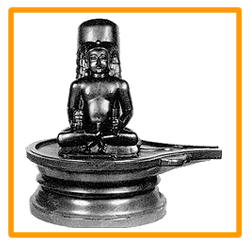
Lord Brahmeshwar Sarva papaharam punyam Shrimat Kayavarohanam
Kayavarohane teerthe murtiman Shankara swayam. Meaning, ‘Kayavarohan is a blessed and auspicious
pilgrimage place which destroys all sin for Lord Shiva himself resides
in his idol there’. The idol in question is the one in the Brahmeshwar
Temple at Kayavarohan built by divine command by Swami Kripalvanand, the
Guru of Swami Rajarshi Muni. It is a unique idol in that it depicts a
human figure superimposed on the top outer surface of a Shiva Linga.
Thus the concept of a ‘linga’, the name Brahmeshwar and the mystery of
the human figure on the linga at Kayavarohan need to be understood. First the linga. A linga is nothing but a material
representation of the formless, attributeless Brahm or Supreme Lord or
Supreme Element. Why it is depicted in its well-known elongated ovular
shape has an interesting history. Once Brahma and Vishnu quarreled as to
who was the greater of the two. The controversy between them went on for
long but found no resolution. Eventually a massive pillar of fire
without beginning and without end appeared between the two warring
Lords. Forgetting their own quarrel both now tried to take measure of
this new apparition before them but were quite unable to fathom its
length or breadth, or depth. They then tried to know its true nature by
the power of their meditation but were still unable to plumb its depths.
Now realizing that they were in the presence of something more powerful
than themselves they bowed before it reverentially and prayed that it
reveal to them its true nature. After long prayer and entreaty, the
pillar of fire and energy and light reduced its own size and assumed the
shape of what has come to be recognized as a Shiva linga. The Supreme
Lord Shiva then appeared in his true form and explained to them that
both were but parts of his own being as indeed was Rudra, the third of
the triumvirate of Gods created to respectively create, sustain and
destroy the created universe and that all were equal, none was greater
or smaller. He went on to say further that a small replica of the
fathomless pillar of fire, light and energy that they had seen would be
his symbol. There is more to the story but the above is enough to
explain the concept of the linga and what it stands for. From times
immemorial thereafter Indian society has worshipped the Supreme Brahm
and Sada Shiva in that form to depict his formless and attributeless
aspect as also several forms to depict his aspect with form and
attributes. In the latter case he has been depicted as Nataraj,
Ardhanarishvar, Samharmurti, Kalhar, Harihar, Uma-Mahesh, Shiva-Parvati,
Pashupati, Bhairav etc. Only in one case has he been depicted as both a
linga and human form and that is as Lord Lakulish, the twenty-eighth
incarnation of Lord Shiva. The twenty eight incarnations of Lord Shiva are
described in the Purans, from which authority we know that Lord Shiva
has incarnated before the onset of every Kali Yuga. The present being
the twenty eighth Kali Yuga it is also the yuga of the twenty eighth
incarnation of Lord Shiva. It is said in the eighteenth chapter of the
Kurm Purana as follows:
Brahmkrityuge devastretayam Bhagvana Ravi
Dwapare Devatam Vishnu: Kalaun Devo Maheshware.
(Meaning, Brahma is regarded as the special deity of
Satya Yuga, the Sun of Treta yuga, Lord Vishnu of the Dwapar Yuga and
Mahesh or Lord Shiva as the special deity of the Kali Yuga).
Over the centuries Indian society has worshipped Lord
Shiva in his many aspects, both in the aspect of nirakar or without
form and attributes and sakar or with form and attributes. These two
categories are distinguished by the linga in the one case and many forms
of Shiva in the other, the latter illustrated by some of the names
listed earlier such as Nataraj, Ardhanarishvar, Samharmurti, Kalhar,
Harihar, Uma-Mahesh, Shiva-Parvati, Pashupati, Bhairav etc. The temples
of Shiva were given names and those where the lingas were made of
meteorites such as in the temples of Somnath, Mallikarjun, Omkareshvar,
Nageshwar, Trambakeshwar etc. were regarded as being of special
significance and potency. The idol at Kayavarohan was established by
Sage Vishvamitra and was known by the name of Brahmeshwar. It
exemplifies the one exceptional instance where Shiva is depicted in both
forms, the linga as well as a human form, the latter superimposed on the
former. This is the depiction of Lord Lakulish, the twenty eighth
incarnation of Lord Shiva, and may be found in temples throughout India,
though in many places the sculptures have been stolen or ravaged. An
idol of Lord Lakulish was recently found in as far away a place as Laos.
Lord Lakulish appeared at the beginning of the present
kali yuga which commenced about five thousand years ago. And he appeared
in human form at Kayavarohan (the word means ‘descent in bodily form’)
near the city of Vadodara in Gujarat. This alone makes the place a
siddha kshetra, land of realized souls, but in addition it is also the
land where Sages Vishvamitra and Bhrigu (after whom the area is also
referred to as Bhrigu Katchh) performed their austerities and where the
Gayatri Mantra came to the former in his sadhana. When the earthly work
of this incarnation was done he disappeared in the linga at the temple
of Brahmeshwar where his devotees still consider him present in the idol
of Lord Brahmeshwar in the form of a human figure (Lord Lakulish)
superimposed on a Linga.
|
||